09.03.2026
International Women’s Day often brings bold statements about progress. But the conversations that stay with you tend to be the quieter, more honest ones.
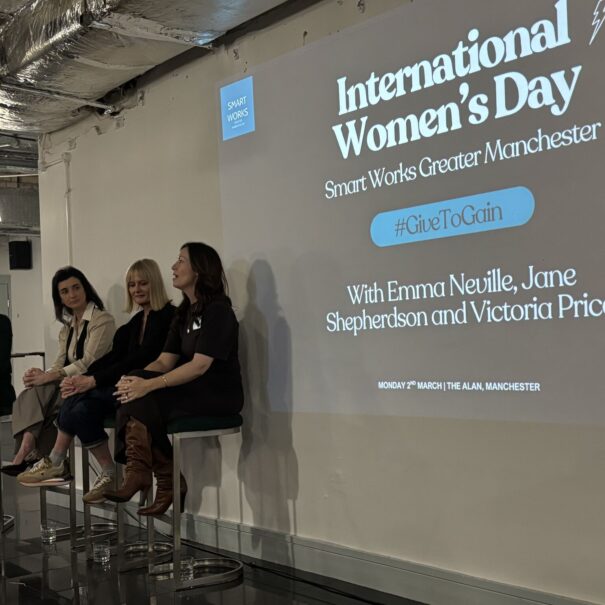
At the International Women’s Day event with Smart Works Greater Manchester, hosted at The Alan and sponsored by N Brown, the theme this year was “Give to Gain”. On paper, it’s a simple idea. In practice, it raises bigger questions about how workplaces support women throughout their careers, and what organisations risk losing if they don’t.
A group of colleagues from Morson attended the event, including Jenniffer Brown, Sam Price, Sophie Lavers, Daisy Walker and Jacqui Jones, joining a room full of people reflecting on the realities behind women’s career journeys.
The panel itself brought together three women from very different professional worlds. But despite their different paths, their stories echoed similar themes: resilience, reinvention, and the importance of building workplaces that understand the full complexity of women’s lives.
The career paths we don’t always talk about
Emma Neville, founder of the menopause support community This is Me, shared a story that’s rarely discussed in professional settings.
At 40, Emma experienced early menopause following a diagnosis of premature ovarian insufficiency (POI). In the UK, the average age of menopause is 51. The lack of accessible information and workplace awareness left her navigating the experience largely on her own.
Her response was to start asking questions. Then to build a community.
That community eventually became This is Me, a space where women can share experiences, access support, and learn about a stage of life that still receives surprisingly little attention in professional environments.
Her story highlighted something the panel returned to several times: many career barriers for women aren’t about capability but about systems that haven’t caught up with reality.
Leadership and representation: progress, but not parity
Fashion executive Jane Shepherdson, CEO of Whistles and former Brand Director at Topshop, spoke about leadership in industries that appear female-dominated on the surface.
Fashion employs large numbers of women. But at board level, the picture often changes.
Jane reflected on the challenges of progressing into leadership positions in environments where decision-making structures don’t always reflect the workforce beneath them.
Her point was simple but powerful: diverse leadership isn’t just about representation. It changes the quality of decision-making.
When organisations invite different perspectives into the room, particularly those early in their careers, they create cultures that evolve rather than stagnate.
Redesigning work around real lives
Victoria Price, founder and Co-CEO of luxury womenswear brand Emello, offered a different perspective shaped by her earlier career in global professional services.
Before launching Emello, Victoria spent two decades leading teams across organisations including EY. Her journey began as a teenage mother, a starting point that required persistence, determination and a refusal to accept traditional career timelines.
One of the most interesting ideas she shared was how she’s structuring her own business differently.
For example, team events are scheduled during working hours rather than evenings, recognising that traditional networking expectations can unintentionally exclude people with caring responsibilities.
It’s a small shift. But it reflects a bigger mindset change: designing work around people, rather than expecting people to design their lives around work.
Five ideas that stayed with us
Confidence isn’t something you wait for
Confidence is often framed as something individuals need to develop internally. But the panel challenged that idea.
Confidence also grows in environments where people’s contributions are recognised and where success (both personal and collective) is celebrated openly.
Sometimes confidence is less about self-belief and more about having people around you who see your potential before you do.
Organisations risk losing talent they can’t afford to lose
One statistic shared during the event was striking: four in ten women leave the workforce during midlife.
The reasons are complex. Health changes, caring responsibilities, and inflexible work structures all play a role.
But the commercial impact is clear. When experienced professionals leave organisations prematurely, businesses lose institutional knowledge, leadership potential and hard-earned expertise.
Supporting women going through these transitions should be a strategic business decision, rather than just a wellbeing initiative.
The real value of “multitasking”
The panel reframed a common stereotype. Women are often described as good multitaskers. But as the discussion pointed out, the reality is more nuanced.
Multitasking is misinterpreted; it doesn’t mean women are great at doing lots of things all at once, but that they are effective in prioritisation. It’s the ability to assess competing demands and decide what matters most.
That ability is more valuable than ever, especially in a world of competing deadlines and fast-moving decisions.
Self-kindness is not a luxury
Emma Neville spoke about the importance of self-kindness, particularly as careers and life responsibilities evolve.
Learning when to pause, ask for help, or set boundaries is a skill, not a weakness.
One that becomes increasingly important during periods of change, including menopause and other life transitions.
Male allies play a critical role
A consistent theme throughout the discussion was the importance of male allies in creating meaningful change as change cannot be women’s voice only.
Not by speaking over women’s voices or even telling her that she has potential, but simply by asking broader questions, challenging bias, opening opportunities and listening with curiosity rather than defensiveness.
Cultural change rarely happens from one side alone.
Beyond one day of conversation
Events like this create space for reflection, but the bigger challenge lies in translating those ideas into action.
Smart Works Greater Manchester continues to play a vital role in supporting women into employment, providing coaching, professional clothing and confidence-building services to help women succeed at critical moments in their careers.
At Morson, supporting women throughout their careers it’s our priority. From encouraging female students and graduates into STEM careers, to advocating for better workplace support around parenthood and menopause, the aim is to remove barriers that still limit opportunity.
Recently, we also became a headline sponsor of the Greater Manchester regional Smart Works Unemployment Index, helping to shine a light on the structural challenges women face in accessing employment.
We’re building workplaces that recognise the full complexity of people’s lives – and creating environments where everyone has the chance to thrive.