27.08.2026
South Korea’s major shipbuilders are turning to automation and AI to tackle labour shortages, safety risks and inconsistent quality across dockyard work. The aim is less about reducing headcount and more about changing how skilled people are deployed. Luciana Rousseau explains:
What’s emerging is a shift away from the manual execution of hazardous, repetitive trade tasks towards human-supervised robotic production. Experienced workers increasingly become robot operators, quality controllers and process improvers, with technology taking on more of the physically demanding work.
So why does this matter?
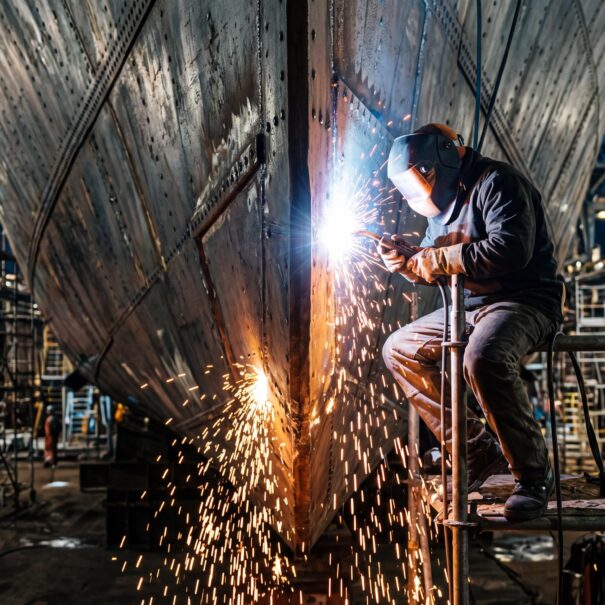
Welding, industrial painting, blasting, and pipe and cable installation are among the hardest marine trade roles to recruit for globally. They can also be a difficult sell to younger workers who see them as dirty, dangerous and physically punishing occupations.
South Korea’s leading dockyards are beginning to change that proposition. Trade knowledge still matters, but it is increasingly applied through digital workflows, machine supervision and AI-supported decision-making. The skills remain. The job around them changes.
Why the South Korean experiment matters
The South Korean shipbuilding sector has become a useful case because its leading firms are scaling automation inside real, high-volume production environments rather than running isolated pilots. HD Hyundai Heavy Industries, Hanwha Ocean, and Samsung Heavy Industries are all deploying robots across welding and adjacent fabrication tasks while describing a future smart shipyard capable of extended or near-continuous automated operation.
The strategy behind this development is clear. Dockyards are dealing with an aging skilled workforce, difficulty transferring tacit know-how, and persistent turnover among replacement labour pools. HD Hyundai reported that many tasks still require five to ten years of experience, but that skilled workers are in short supply, so the yard is concentrating experts on complex work while training lower-skill workers to operate robots in standardised sections.
From trade execution to trade-enabled supervision
The most important lesson is that South Korea is not removing craft skill from production, but it is codifying and redistributing it. At HD Hyundai’s Ulsan operations, workers now move among multiple welding robots with tablet PCs, acting more like conductors than manual welders, while the robots execute repetitive welds under digitally defined parameters.
This creates a new occupational model for dockyard automation. Instead of one welder producing one stream of output, one operator can supervise several robotic cells while still drawing on trade judgment to set up work, manage exceptions, verify bead quality, and intervene where geometry or access becomes difficult. In practical terms, the role becomes “machine minding plus trade intelligence,” which is closer to advanced manufacturing technician work than to the traditional image of a grimy manual trade.
What dockyard automation skills looks like in practice
HD Hyundai Heavy Industries
At HD Hyundai Heavy Industries, compact robots are being deployed inside narrow internal block spaces that have historically been difficult to automate because of restricted access and complex geometry.
According to the company, a robot working on confined block welding can handle four times the welding volume one person can complete in a day. The next stage of deployment is designed to allow one worker to operate as many as eight robots simultaneously.
But speed is only part of the story. The robots use laser sensing to scan joints, identify groove position, width and depth, then weld according to conditions linked to design data. More consistent bead quality can reduce the need for noisy, dusty grinding-based finishing, cutting rework and downstream disruption.
There is also a longer-term skills play. HD Hyundai says shop-floor apprenticeship knowledge is being preserved as data and used to train AI systems, with the aim of enabling robots to recognise and weld different block shapes more autonomously.
Veteran know-how, in other words, can become part of a production system that is easier to scale. That creates a different question for shipbuilders facing persistent skills shortages. The challenge may no longer be simply how to find more welders, painters and fabricators. It is how to redesign those roles so scarce trade expertise can stretch further, while making the work safer, smarter and more attractive to the people coming through next.
Hanwha Ocean
Hanwha Ocean provides perhaps the clearest example of dockyard skills augmentation rather than replacement. At its Okpo Shipyard, one AI welding robot works at roughly the same speed as a skilled worker. But with one operator able to oversee four or five robots, hourly throughput can increase four to five times.
That distinction matters. Productivity comes from extending scarce human expertise across several robotic assets, rather than simply making each weld faster.
Hanwha reports that automation for indoor welding at Okpo has reached 67%, with an ambition to fully automate welding by 2030. It also aims for robots to handle 50% of pre-treatment painting by then, particularly higher-risk blasting work. As machines take on more of the physical execution, human expertise shifts towards process design, inspection, exception handling and system oversight.
Samsung Heavy Industries
Samsung Heavy Industries is following a similar path, applying robotics across steel cutting, subassembly welding and mobile systems designed for difficult shipyard environments.
Trials have included a walking robot for welding and inspection on ship blocks, with deployment targeted across welding, inspection and painting tasks from 2026.
For labour-intensive and hazardous work, the direction is clear: move more physical execution to machines while giving skilled people greater oversight of production.
What this means for welding, painting and blasting
For welding, the South Korean model points to a layered division of labour. Robots take over repetitive, ergonomically punishing, or access-constrained welding passes, while people handle setup, sequencing, supervision, complex joints, troubleshooting, calibration, and assurance of final quality.
For industrial painting and blasting, the emerging pattern is similar. The dirtiest and riskiest elements of surface preparation can increasingly be handled by robotic systems, while human skill shifts toward assessing substrate conditions, setting process parameters, validating coating integrity, and managing exceptions where variable corrosion or geometry makes full automation difficult.
For the labour market, this changes the narrative around these occupations. Jobs that were once associated mainly with grime, fumes, confined spaces, and repetitive physical strain can be reframed as hybrid roles combining trade literacy, robotics oversight, HMI or tablet control, quality verification, and AI-supported production management. This repositioning is particularly important for attracting emerging talent who may reject traditional trade identities but are more open to digitally mediated technician roles in advanced industry.
Why augmentation is central
Three features of the South Korean case show why augmentation is a better interpretation than displacement.
- First, the companies continue to emphasise the scarcity and value of experienced workers, not their redundancy.
- Second, productivity gains are repeatedly described in terms of one worker supervising multiple robots, which implies leverage of human expertise rather than wholesale removal of it.
- Third, AI is being trained on accumulated work data and tacit process knowledge, meaning expert practice is being embedded into systems that less-experienced workers can use effectively
This creates a more resilient workforce architecture.
Senior tradespeople become:
- knowledge donors
- robot trainers
- exception managers
- quality authorities
Mid-career workers become:
- cell leaders
- multi-robot operators
Newer entrants can join through technician pathways that are cleaner, safer, and more digitally legible than legacy dockyard roles.
Implications for skills strategy
A practical skills strategy based on the South Korean example would NOT treat automation as separate from trade development. It would redesign workforce pipelines around blended competencies. Welding or coating fundamentals, robot operation, digital interface use, basic data interpretation, maintenance awareness, and process-quality control.
This also suggests a different employer value proposition for hard-to-fill industrial roles. Rather than recruiting into “dirty jobs,” shipyards can recruit into safer, higher-tech production careers where workers still build real craft credibility but do so through supervision of intelligent systems, better ergonomics, and visible progression into advanced manufacturing roles.
South Korea’s dockyard leaders are showing that AI and automation can expand the productive reach of scarce trade skill, especially in welding, painting, blasting, and confined-space outfitting. The most persuasive examples do not show craft disappearing, they show craft being multiplied through robotics, software, sensing, and data capture.
For policymakers, employers, and workforce planners facing a global shortage of welders, blasters, painters, and marine fitters, the key insight is that automation works best when it converts tacit manual capability into scalable human-machine systems.