Projets
→
Gleeds Infrastructure: How proprietary behavioural science built strategic AI advantage
Like most organisations in the built environment, Gleeds Infrastructure faced a familiar dilemma, AI was moving from experimentation to expectation, but leadership had no reliable way to know how their own people actually felt about it. Morson’s AI Archetype Mapping gave Gleeds Infrastructure evidence of workforce AI readiness, and where to target investment.
Was the workforce ready to embrace AI-enabled ways of working, or would rollout stall on hidden pockets of anxiety, scepticism or disengagement?
Synopsis
Most AI sentiment surveys treat a workforce as a single audience. In practice, attitudes to AI vary by role, seniority, career stage and past experience, and an AI programme that ignores those differences risks stalling on resistance nobody saw coming.
Morson Group’s Client Innovation team, led by doctoral researcher Luciana Rousseau, ran its proprietary AI Archetype Mapping across Gleeds Infrastructure’s UK workforce. The research, built on an established behavioural framework and refined through Morson’s own applied research, was tailored specifically to Gleeds Infrastructure’s context and cross-referenced against job role, tenure, age and prior AI training. It turned a single data point into a genuinely strategic diagnostic, classifying individuals into clear, meaningful AI mindset profiles rather than vague “for or against” labels.
This is not off-the- shelf survey software. It is applied behavioural research, grounded in organisational psychology & real life, organisational practicalities, delivered by specialists with deep sector context across infrastructure, construction, energy, aerospace and defence.
The results changed the question leadership was asking. They had planned for “how do we overcome resistance?” The evidence pointed them to “how do we channel readiness?” The research also showed why Gleeds’ existing AI training had not, on its own, changed how people felt about AI.
Damien Savage, Senior Director, UK Infrastructure, Gleeds
AI has significant potential to enhance the way we work and the value we deliver for our clients, but realising that potential is not simply about giving people access to new technology. We need to understand how our teams perceive AI, where they see opportunities and where they have legitimate questions or concerns.
The findings are encouraging and give us practical insight that can help shape how we approach adoption, training and governance. By understanding our people first, we can ensure we take them with us as our use of the technology evolves.
Download the case study to find out:
- What the research showed about attitudes to AI across career stages, tenure and age, and the common assumption it overturned
- Where caution sat inside the organisation, and why it needs targeted engagement instead of generic messaging
- Why culture shapes AI mindset more than training courses do, and what that means for L&D spend
- The commercial benefits for Gleeds, from investment confidence to faster time to value in forecasting, reporting and commercial analysis
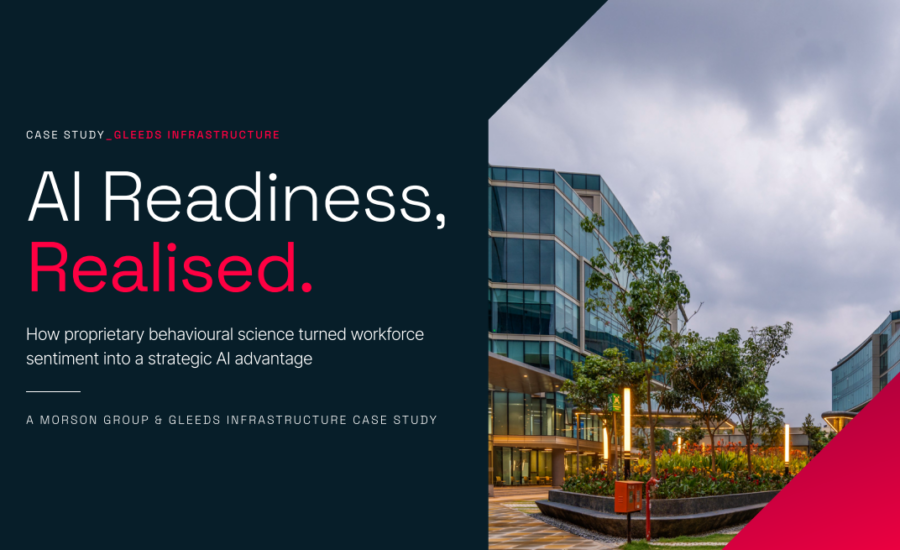
Gleeds Infrastructure: AI adoption case study
AI is reshaping how work gets done across infrastructure, energy, defence, rail and technology. But most organisations are still treating […]
Les règles du travail sont en train d'être réécrites. Les marchés changent du jour au lendemain. Les écarts de compétences se creusent chaque jour. Les modèles traditionnels de main-d'œuvre ne peuvent pas suivre. [...]


 English
 French