19.05.2026
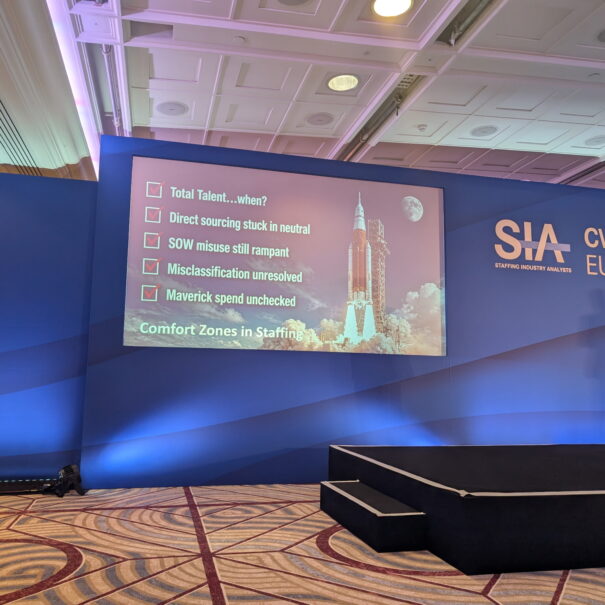
That question posed by Peter Reagan Senior Director, Contingent Workforce Strategies Council, SIA in the opening SIA CWS Summit keynote, was not rhetorical. Six years of consecutive disruption have produced two dominant organisational demands: resilience and agility. Contingent workforce strategy has been the pressure valve for both. The keynote’s central argument was that too many organisations have mistaken the pressure valve for a strategy.
The numbers frame the scale of the problem. Global spend on contingent work is $10.2 trillion. Sixty per cent of US work is now performed by independent contractors, not because organisations designed it that way, but because workers chose it. People are choosing flexibility and autonomy over traditional employment at a rate that most contingent workforce programmes were not built to accommodate.
Those programmes are catching up slowly, and in the wrong direction.
Bottlenecks dressed as governance
The keynote named four structural habits now treated as standard practice, each of which creates friction at the point where speed and access matter most.
Cost-first KPIs that price the transaction and ignore the capability outcome. Supplier panels rigid enough to exclude the talent that sits outside them. Compliance frameworks engineered for risk avoidance rather than speed of access. And data reporting so fragmented that programme leaders cannot see their total workforce composition in a single view.
These are not execution failures. They are design failures, programmes built for a control model that no longer matches how work is acquired, or how workers choose to offer it.
The consequences are concrete. IT staffing has declined in the same period that consulting spend has risen, because organisations could not access specialist technical resource through their own contingent channels and bought it through statement of work (SoW) instead. SoW misuse is now widespread. Worker misclassification is unresolved. Direct sourcing, after years of industry discussion, is still not progressing at scale.
The keynote’s framing, bottlenecks disguised as best practices, is accurate. These are not problems organisations have failed to notice. They are problems organisations have learned to route around, and in doing so, have written the workaround into process.
The programme design problem
The contingent workforce strategy keynote also raised a question that sits at the heart of every hybrid programme design: how do the functions actually work together? The data from the keynote was pointed, HR owns approximately 50% of programme governance, Procurement 54%, Engineering 1%. Those numbers do not add up to a coherent operating model. They add up to overlap at the top and a near-total absence of the people who understand what the work actually requires.
A programme designed without the end-user in the control loop cannot adapt to what the business needs, because the business, the people delivering the work, has no formal voice in how the programme runs. The organisations that will define what good looks like in the next five years are those that fix that imbalance before it becomes a competitive liability.
The EU AI Act is not a future consideration
For programmes operating across European markets, the EU AI Act places employment-related AI applications in the high-risk category, alongside social scoring and facial recognition systems. Human oversight is mandatory, not advisory.
Any contingent workforce programme integrating AI into sourcing, screening, or classification decisions needs governance that can demonstrate that oversight, not just assert it. The organisations that will hold competitive position here are not those moving fastest with AI adoption. They are those with the governance architecture to prove that a human was in the loop, and what that human decided.
The threat landscape compounds this. The keynote identified AI-generated identity fraud, bot-driven credential attacks, and agentic AI replication as present risks, not projected ones. Programmes built on the assumption of human actors in every transaction are not currently designed to detect or withstand them.
What TA looks like in 2030
The keynote’s projection for 2030 is that talent acquisition and automation will be so integrated that treating them as separate functions, with separate budgets and separate conversations, will not be viable. The question will not be whether to combine them. It will be whether the combination was designed intentionally or arrived at by default.
The organisations best placed for that future are building now what the keynote described as a single ecosystem: internal mobility, alumni networks, and external talent pools operating from shared data and a shared activation model. Skills-based. Visible end to end.
The keynote closed with a leadership sequence that functions as a diagnostic: visibility leads to velocity, velocity to value, value to trust, trust to adoption. Organisations that cannot achieve visibility of their total workforce, spend, and composition cannot progress through the chain. The rest is noise.
That sequence, visibility, velocity, value, trust, adoption, is precisely what the Morson Group structure is built to deliver: with Morson Praxis designing and delivering the programme architecture, Morson Edge and Morson Vital providing the engineering and technical expertise to execute within it, and Morson Nexus connecting sustainable human infrastructure that holds it together, clients have a single partner across every stage of the chain, not four separate conversations with four separate suppliers.
Morson Edge: what we see from the ground
The Summit keynote described a structural problem Morson Edge works inside every day.
The organisations we work with are not short of ambition for their contingent programmes. They are short of the infrastructure to execute it: incomplete workforce data, compliance frameworks that slow hiring rather than protect it, and MSP or VMS arrangements that were scoped for a simpler market and have not kept pace with how technical and specialist talent now moves.
The $10.2 trillion figure cited in the keynote is not an abstraction. It is the sum of thousands of programmes making the same set of trade-offs: control over agility, process over speed, cost reduction over capability access. Most of those trade-offs were reasonable when they were made. Most of them are now costing more than they save.
The conversation we have most often with senior programme leaders is not about technology. It is about what a programme is actually for. Whether it is designed to manage supplier relationships or to deliver workforce capability. Whether visibility of spend and headcount is being used to make decisions or to produce reports. Whether the people running it have the authority to change what is not working.
If your contingent workforce programme was designed more than three years ago, it was designed for different market conditions, different regulatory requirements, and a different picture of how independent workers engage. A structured analysis of where it stands now takes four weeks and produces a gap analysis your board can act on.
Request a Workforce Performance Diagnostic, for an end to end view of your contingent workforce strategy, to help you find where value leaks, inefficiencies hide, or compliance slips.




 English
  French